I know…everyone already knows that the mail is slow. What is new is that the US postal service has changed the way it applies the postmark to each piece of mail. Instead of postmarking items at the individual branch on the day they were mailed, the USPS has started delaying the application of the postmark until items reach a centralized processing center. Depending on your location, this could mean that your mail doesn’t get postmarked until one or two days after you mail it.
This is a problem if you are trying to mail something to the IRS.
The IRS technically considers a form to be filed and/or a payment to be received upon the date the item is placed in possession of the postal service, aka “the postmark date”. If you got the item into the current day’s mail, it used to be postmarked that day. This is no longer the case.
Even though so very many things can be filed and paid electronically, there are still occasions where something must be filed on paper. What should you do if you have to entrust an IRS filing to the USPS? Well, here are a couple of ideas:
Ensure you have applied sufficient postage
Send your IRS document using certified mail (for proof of mailing date)
Take your IRS document to the window to have the postmark stamped manually
Mail your IRS document very early so it arrives timely
All of the above
Document everything you can, file as early as you can, and maybe…I dunno…burn a Forever stamp as a sacrifice to Postmaster General Steiner?
There it is. Right there in between the Val-Pak and the Kroger circular it’s…it’s…a letter from the Internal Revenue Service.
Yikes.
I have written about this before, and I encourage you to go read that post for still-relevant info about IRS correspondence. Here are a couple things going on currently in the world of IRS notices…
Apparently, the IRS is “catching up” on a bunch of notices from returns filed in previous years, some as far back as tax year 2021. Most of these notices are computer-generated, meaning they are untouched by human hands (except yours, I guess, when you open the letter). Before you begin your response, you should make sure the notice date is not later than three years from the original filing date of your tax return.1
There is, however, a recent issue with IRS notices for 2024 tax year returns. Though no one seems to know the exact cause, it appears that there may be a “glitch” in the IRS systems. In recent weeks, taxpayers have been receiving IRS Notice CP59 for tax year 2024. This is the notice the IRS sends to notify you that your tax return is considered “delinquent”2. It may also include an assessment of the tax the IRS thinks you owe based on your reported income (from Forms 1099, W-2, etc). Here’s the glitch — many of the taxpayers who have received these notices have either already filed a 2024 tax return or filed a valid extension of time to file by October 15, 2025. At this time, there has been no acknowledgment from the IRS that these notices are in error; the Texas Society of CPAs is currently investigating. Stay tuned…I’ll update this post as new information becomes available.
The question on everyone’s mind is, ‘What should I do if I get one of these erroneous notices?’ Well, even if the notice is inaccurate (i.e., you filed a valid extension or already timely filed your tax return), you should still respond. If the notice assesses tax, the IRS only allows you a 90-day window to respond before they will begin the collection process. Things move slowly through IRS channels, so it is best to respond as soon as possible. Consult your tax advisor if you need assistance.3
Finally, I would advise you to log into your taxpayer account at IRS.gov to check and see if any notices have been generated.4 Once you log in, there is a menu option at the top of the screen called “Notices and Letters”. This will show you any IRS correspondence on your account.
As always, I provide this for informational, educational, and entertainment purposes. It is not intended as advice on your specific tax situation. Please consult your tax advisor.
Statutorily, the filing date is the later of the original due date (usually April 15th-ish) or the date you actually filed it. So, if you e-filed on March 28th, the filing date is April 15th. If you mailed a paper return postmarked on October 12th, the filing date is October 12th. ↩︎
Delinquent means that the tax return has neither been filed nor extended and the due date has passed. ↩︎
Seriously, call your tax person. They need to know about this, and you will likely want/need their help with it. ↩︎
If you have not set up an ID.me account in order to log into your IRS.gov (and also SSA.gov) account, please do that as soon as possible. ↩︎
Currently, FinCEN BOI reporting is not required for domestic entities created in the United States. Quoting from their website:
All entities created in the United States — including those previously known as “domestic reporting companies” — and their beneficial owners are now exempt from the requirement to report beneficial ownership information (BOI) to FinCEN. Existing foreign companies that must report their beneficial ownership information have at least an additional 30 days from March 26, 2025—until April 25, 2025, for most companies—to do so.
Did you know that your account with the IRS does NOT have to be a black box? Believe it or not, every taxpayer can see their IRS account activity by setting up IRS online access. Given the fact that the IRS faces some…um…funding and staffing issues due to the powers that be in the White House and Congress (and…DOGE?), it will be ever more difficult to be able to speak with an actual human (let alone a human that has any clue what they are talking about) when you call the IRS. So I think it is crucial to use any tools we have at our disposal. And this one is pretty powerful — read on!
OK, but how? To set up your account, go to the IRS website via this link. There, you will click the big blue button for “Sign in to your online account”. If you have an existing account, click the button for “Sign in with ID.me”. If you don’t, click the other button for “ID.me create an account”. From there, you will need to go through some ID verification and set up your email and phone number for multi-factor authentication. I won’t lie, I found it to be a slightly cumbersome process, so set aside a bit of extra time for this. But once you get it set up, you should be good to go.1
What information can I get from this account? Once you log in, you can see what the IRS has in your taxpayer account for the last four years (2021-2024 at the time of this writing). It’s a good idea to check this periodically to make sure nothing is amiss. You can see…
transcripts for prior tax returns filed
the wage and income documents2 reported under your profile
any IRS notices outstanding
info on any ongoing audits
a few other interesting tidbits
You can also get an identity protection personal identification number (“IP PIN”) by going to the “Profile” section at the top of the screen. Once you click there, scroll down and you will be given an option for an IP PIN.3 Another really handy thing is the ability to approve a power of attorney through your account.4
But what about information security? I mean, the IRS already owns you — SSN, address, date of birth, bank accounts — they have it all. If they can’t do information security, we are all doomed. However, if you are concerned about receiving this information through your internet connection or browser, then perhaps you should consider upping your security game. For starters, don’t set up this account or access it on public WiFi. If you are concerned about the security of your home internet, you should consider installing a new router, getting a VPN, and/or upgrading your antivirus to a more robust package. We must all be proactive to protect ourselves as much as possible these days.
So, what are you waiting for? Go set that account up so it’s there when you really need it!
This same login will also get you into your Social Security account at SSA.gov. There, you can print out your complete Social Security wage history. ↩︎
The wage and income documents for 2024 won’t likely show up until sometime around April 2025. Please do not rely on this as the source for your documents for tax prep. The information there is often truncated/incomplete, so it makes it difficult or impossible for your tax preparer to parse for a tax return. If you are missing a document, you should first contact the issuer of the document to request a replacement. You should also do your best to keep your mailing address (and email) current with your employer(s) and/or contractors by filling out the appropriate Form W-4 or W-9 each time you move. This will help those forms make it to you in the first place. ↩︎
If you choose to get an IP PIN, be sure to give it to your tax preparer as they will not be able to file your tax return without it. I *highly* recommend that all taxpayers get an IP PIN. ↩︎
This is PRICELESS if you need me to call the IRS on your behalf to resolve an issue or respond to a notice. Otherwise, it is a morass of signature collection and faxes (no, seriously, faxes – welcome to 1995!) that may or may not make it to the correct IRS agent. It is also much more secure than a fax machine. ↩︎
The FINE Print: This is provided for information and entertainment purposes only. It is not meant to address any specific tax issue nor can it be considered personal tax advice. Please consult your tax advisor for guidance.
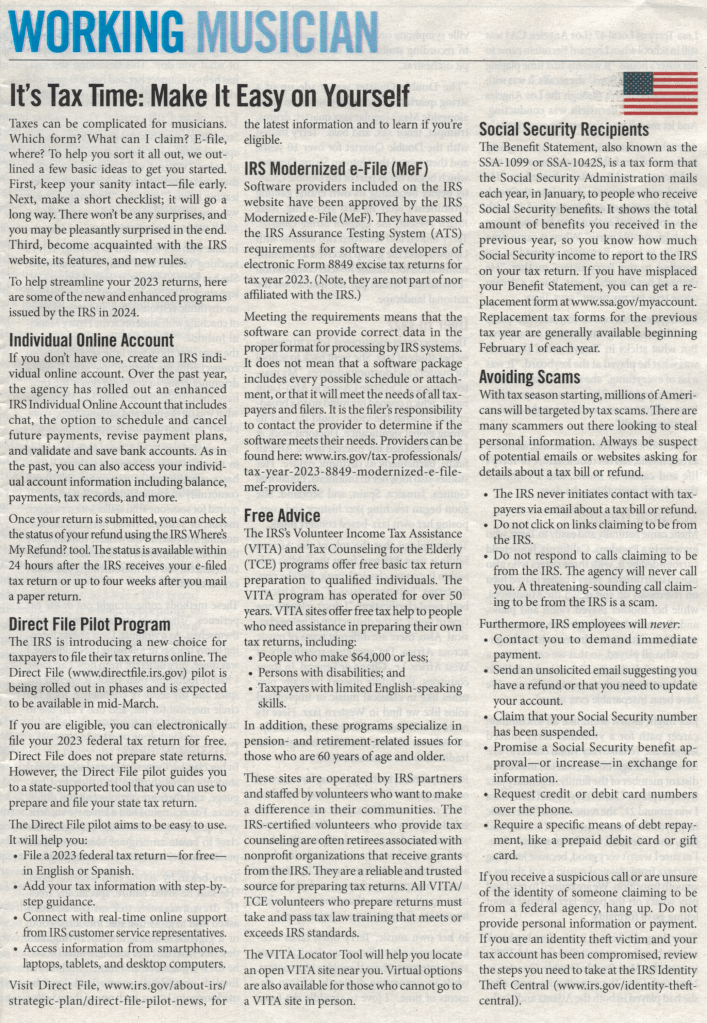
This article appeared in the March 2024 issue of the American Federation of Musicians’ magazine, International Musician. I did not write the article and no author was credited. It is a good collection of general tax information as well as a warning about some IRS scams (some of which I have already covered in earlier posts). I am posting it here for a limited time. If you are a member of the AFofM, flip to page 14 of this IM to read the original article. If you are a musician, and are not a member of the AFofM, I strongly encourage you to join your local chapter.
This is the closest thing to a 20-pound box of chocolates from the IRS…
There are very few things in the tax code that are rigged in favor of the taxpayer. The Roth IRA is pretty good…but the one that pulls out all the stops is the Health Savings Account (“HSA”). An HSA is a tax-advantaged account for the payment of qualified medical expenses. It is available to taxpayers who are covered by health insurance that qualifies as a high deductible health plan (“HDHP”)1. There are several reasons why I think the HSA may be even better than that tax-advantaged darling, the Roth IRA. Read on!
HSA Contributions. Contributions to an HSA are deductible in the year of contribution (take that, Roth IRA – ha!). If contributed directly to an HSA account, they are deducted from your adjusted gross income (“above the line” – the good kind of deduction). If they are contributed through an employee’s payroll deferral, they are pre-tax and exempt from employment taxes (i.e., FICA and Medicare). Additionally, employers are permitted to partially or fully fund their employees’ HSA accounts free of tax to the employee. Maximum contributions are based on the type of coverage an employee has under an HDHP:
Type of HDHP coverage
2023
2024
Employee only
$3,850
$4,150
Family
$7,750
$8,300
Age 55+ catch-up contribution
$1,000
$1,000
This allows a married couple with family HDHP coverage and both spouses age 55 or older to contribute a total of $10,300 ($8,300 + $1,000 + $1,000) to their HSA accounts in 2024.2
HSA Distributions. Distributions from an HSA are tax-free if they are used to pay or reimburse eligible medical expenses3. This can include costs for doctors, dentists, hospitals, lab tests, and prescriptions as well as certain over-the-counter items such as NyQuil, Advil, Bandaids, sunscreen, tampons(!), and condoms(!!). The funds can also be used to reimburse certain Medicare and long-term care insurance premiums. These eligible distributions can be taken at any age and can occur either the year the medical expense is incurred or any year thereafter. For a taxpayer under age 65, any distribution in excess of eligible medical expenses will be subject to tax plus a 10% penalty. Taxpayers 65 or older are permitted to take HSA distributions for any reason without penalty, but the distribution in excess of medical expenses will be taxable.
How is this different from flex-spending? So, this HSA sounds pretty good – deductible contributions, non-taxable distributions – but how is it different than a flex-spending account (“FSA”)? If you have an FSA, you are familiar with the concept of “use it or lose it”. Such is not the case with the HSA. The HSA funds belong to the taxpayer and can be kept in the HSA for years, even after separation from an employer.
So what’s the strategy? The strategy for maximum HSA benefit is to treat it just like you treat your other retirement accounts: invest that money and leave it alone! In the meantime, pay your medical expenses out-of-pocket and (this is key) save your medical expense receipts. Then, years later, once your HSA investments have grown, reimburse yourself for those prior year medical expenses tax-free. This way, you maximize the tax advantage of the income and appreciation of your HSA investments.
HSA Summary and Example. The HSA is a triple tax benefit…
Contributions are deductible/pre-tax (and not subject to payroll tax)
Distributions (including any appreciation) for medical expenses are tax-free
Trixie Taxie, 51, and her wife Lexie, 56, are covered by a family HDHP plan at Trixie’s work in 2023. Trixie takes full advantage of the available HSA, contributing $7,750 from her paycheck. These funds come out of her check pre-tax and are not subject to FICA/Medicare payroll taxes. Because Lexie is 55 or older, she is eligible to contribute a 2023 catch-up contribution of $1,000 in addition to the $7,750 Trixie has already contributed. Lexie must establish an HSA in her own name and contribute the additional $1,000 by April 15, 2024. Lexie’s contribution will be deducted directly from adjusted gross income on the couple’s 2023 joint income tax return. Both spouses invest the funds as instructed by their personal financial advisors.
In 2023, Trixie and Lexie have their usual medical expenses and also purchase some over-the-counter medicines and supplies. They pay for these expenses out of pocket and save the receipts, leaving their HSA funds to grow in their investments.
Fast-forward to 2040…Trixie and Lexie are both retired and on Medicare. The $8,750 they put into their HSAs and invested wisely in 2023 has now grown to over $20,000. They can use this money (all $20,000 of it) tax-free to reimburse themselves for their Medicare premiums or for any other prior or current year eligible medical expense. Remember those medical expense receipts they saved back in 2023? They can reimburse themselves for those at any time.
It’s just too good to pass up! If you were covered by an HDHP in 2023, you have until April 15, 2024 to fully fund this miraculous account. Don’t miss out!
Any taxpayer on Medicare is no longer eligible to contribute to an HSA. ↩︎
This would require both spouses to have HSA accounts and at least $1,000 would need to be contributed to each spouse’s account. However, both spouses could be covered by the same HDHP. ↩︎
Expenses must be incurred after the HSA is established to be eligible for reimbursement. ↩︎
Tax-free if distributed for qualified medical expenses; tax-deferred if distributed for any other reason. ↩︎
I provide this for educational and entertainment purposes only. Please consult your own advisors.
You may qualify for dependent care credit, but you need to have all the info.
When you brought that little tax credit…er…I mean bundle of joy…home from the hospital, you knew your life was going to change. You now have this tiny, helpless creature that must be supervised and cared for. All. The. Time. At some point in time, it is very likely that you will need to pay someone to care for your offspring while you venture forth to make money in order to house, feed, and clothe this brand new human. If you do so, you may be eligible for something called the Dependent Care Credit1.
What expenses can I claim for this credit? Subject to a few limitations, it is generally any unreimbursed2 payments you make for child care of a dependent under age 13 while you are working3. This can be self-employed work or W-2 employment. Here are a few examples of unreimbursed child care payments that would qualify:
Great – I paid a ton of money for that. What do I do to get this credit? In order to claim the credit, you need to give your tax preparer the following info on each care provider:
Name of provider
Provider tax identification number (EIN or SSN)
Provider address
Care location (if different)
Provider phone number
Amount paid during the tax year, allocated to each dependent
You noticed the second item – tax ID number. This information is usually listed on the year-end statement provided by most daycare centers, day camps, or other care providers. If you employ a nanny, you should have this from the Form W-4 you collected when you hired them (because you are sending them a W-2, right? <nod with me>). However, if, for example, you paid a neighborhood kid or two to watch your children while you worked, you will need to get a Form W-10 to request the social security number of those providers. If you think you will need a Form W-10, request it as soon as possible.6
I can work with that. How much credit do I get for this? It’s actually a bit disappointing. The credit is figured on a sliding scale based on your modified adjusted gross income. Without getting into a whole bunch of math, I find most people max out this credit at $600 for one qualifying dependent and $1,200 for two or more.7 But, hey, better than nothing. And you never know what those crazy folks in Congress are going to do with the tax code.
So, as you gather up your tax data, be sure to collect those dependent care expenses and all the info that goes with them!
This credit is in addition to the general child tax credit you may be eligible for. ↩︎
Childcare expenses that are reimbursed through an employer’s flexible spending arrangement (“FSA”) are not eligible for this credit. But if you have dependent care expenses in excess of the FSA reimbursement, they can be used to claim this credit. Additionally, your tax preparer needs to report at least the amount of dependent care expenses as you claimed during the tax year. So you still need to give them all this information. ↩︎
This credit is also available for other dependents like disabled parents or disabled older children. However, I am limiting this post to dependent care credit for children under age 13. ↩︎
If you hire a nanny or a related party for child care, there are some additional requirements in order to render these payments eligible for the credit. ↩︎
Seriously, people have tried to pay the other parent to “babysit” their own child. You cannot babysit your own child. It’s called parenting. /rant ↩︎
In the future, it is better to get the Form W-10 from the provider before care commences or payment is made. Also, this does not mean you will be required to issue any sort of Form 1099 to the provider(s). ↩︎
This is calculated based on the tax law in effect at the time of this writing. There is legislation pending in Congress that could alter this and other child-related tax credits. Please consult your tax advisor for the most recent developments. ↩︎
AS OF FEBRUARY 18, 2025 THE INJUNCTION THAT WAS PREVIOUSLY IN PLACE HASE BEEN LIFTED. THE FINCEN WEBSITE HAS POSTED A NEW DEADLINE OF MARCH 21, 2025. PLEASE CONSULT YOUR ADVISOR TO ENSURE YOU COMPLETE THIS REGISTRATION IF YOU ARE REQUIRED.
Who the heck is FinCEN and why do I have to register with them?
Ah, the federal government is at it again…coming up with more hoops for us to jump through. I guess Congress needed to do something to earn their compensation. (C’mon, the holidays, the health insurance, the pension…they should actually have to do some work…) Unfortunately, the “work” they do is actually creating more work for some business owners in the form of FinCEN Beneficial Ownership Information reporting.
What is FinCEN? ”FinCEN” is short for Financial Crimes Enforcement Network (the federal government does love their quirky little acronyms). Their mission, as stated on their website, is as follows:
The mission of the Financial Crimes Enforcement Network is to safeguard the financial system from illicit use, combat money laundering and its related crimes including terrorism, and promote national security through the strategic use of financial authorities and the collection, analysis, and dissemination of financial intelligence.
That is a long sentence with a lot of commas. What does it boil down to? They are a federal agency created to prevent money laundering and identify funding of illegal activities like terrorism. In theory, this sounds like a good thing. However, they have cast a wide net in the pursuit of this mission; a lot of plankton will be tangled up in order to catch the whale.
OK, what did they do? FinCEN implemented a program called “Beneficial Ownership Information” or “BOI”. Under this program, most entities formed through the filing of documents with the secretary of state of a US state or territory (or a foreign jurisdiction) now have a legal obligation to file a Beneficial Ownership Information Report with FinCEN. This applies to you if you are…
a corporation (Subchapter S or C)
a partnership (limited partnerships or other registered partnerships)
an LLC (even single-member LLCs)
Well, am I going to have to file? The short answer to that is ‘probably yes’ if you are organized as one of those entities. There a a number of exemptions, but they are pretty specific so most entities are unlikely to qualify for one. FinCEN BOI reporting does not apply if you are an sole proprietor (even with a registered DBA or an EIN) or an unregistered general partnership/joint venture. But if you are a teeny, tiny single-member LLC, you will likely be required to file a BOI report. Additionally, if you reside in a community property state (like Texas), both spouses will need to register even if only one spouse is the named owner.1 (Like I said, a lot of plankton will be tangled up in this.)
What happens if I don’t file? How good do you look in orange? If you fail to file, you risk fines of up to $10,000 and imprisonment up to 2 years. It is not in your best interest to ignore this.
Ok, ok, orange is not my color.When do I have to file this? Soon…
If your entity was already in existence and registered with a secretary of state on January 1, 2024, you have until January 1, 2025 to file your initial report.
If your entity was set up on or after January 1, 2024, and before January 1, 2025, you have 90 calendar days to complete and file this BOI report.
On or after January 1, 2025, new entities will have 30 calendar days to comply.
Then, if ANYTHING changes (i.e., you move, the business address changes, there is a name change, there is a change in the ownership of the company, there is a change/expiration to the document you used to register) you must file a corrected report within 30 calendar days or risk the abovementioned penalties for noncompliance. (Is orange still the new black?)
Wow, this is crazy.But I’m sure you’ll stay on top of this for me, right o beloved CPA? Nope. Even though I look fabulous in orange, I prefer a muted coral over…um…federal penitentiary orange. At this time, I am not offering this service. However, I point you in the direction of the FinCEN BOI reporting website right here and an instruction guide here. I am happy to answer questions to the best of my ability, and will send out the occasional reminder as we get closer to the end of the year, but I will not prepare or file these reports on your behalf. If you would like to engage a professional to complete this for you, I suggest you consult your attorney.
I provide this for information and entertainment purposes. It is not meant to be advice for your specific situation. Please consult your attorney or other advisor for assistance with your FinCEN compliance needs.
This is applicable if the entity interest is community property. If, for example, it was acquired through gift or bequest, was owned by one spouse prior to the marriage, or was partitioned as separate property as part of a premarital agreement, it may be considered separate property. Generally, in community property states, the default assumption is that all property is part of the community. So please consult your legal advisor if you think your ownership interest might be considered separate property. Additionally, if you have already registered and did not register your spouse as community property owner, consult your advisor. You may need to update your registration as soon as possible. ↩︎
If you are an independent contractor (aka “a freelancer”), chances are good that you have been the recipient of a Form 1099-NEC (or several) somewhere along the way. However, did you know that you may be required to file them too? Read on…
Why, you ask, would I need to file such a form? Well, if you paid any person(s) $600 or more to provide services in the course of your business1 during 2023, you are required to prepare and file Form(s) 1099-NEC2 for them by January 31, 2024.
What do you mean “person”? Well, a “person” in this circumstance is an individual, sole proprietor, partnership, or LLC that is NOT organized as a corporation. So, if you paid Frank the Painter, Inc. (an S-Corporation) $700 to paint your rental house, you are off the hook and do not have to send a 1099 to his corporation. But if you hired Gina Smith, an unincorporated sole proprietor, to repair your rental house plumbing for $600 or engaged Dewey, Cheatham & Howe, LP for $1,000 of legal consulting3 for your self-employed business, you will need to send Gina and/or DC&H a Form 1099-NEC.
What if I paid a guy I found on Craigslist $750 to buy a water heater for my rental? Do I need to send that guy a 1099-NEC too? Nope, 1099-NECs are only for service or labor payments, not purchases of goods or equipment. However, if you are issuing a Form 1099 to a contractor who supplied or installed materials and equipment incidental to the services they were providing, then you would include the entire amount of the payment on the Form 1099.
Okay, well what do I need to do to prepare these 1099-NECs? The first thing is you need to get a Form W-9 from anybody you paid $600 or more during 2023. (Really, it is better to get the W-9 from anyone your business hires before any work commences or money changes hands…but better late than never.) This will give you the person’s legal name, current address, taxpayer identification number/social security number, and a confirmation of their federal tax classification (i.e., individual, partnership, corporation, etc.). Then, if you plan to prepare and file the Forms 1099-NEC yourself, I would take a peek at the IRS Form 1099-NEC filing instructions for some guidance. You can either purchase the special paper 1099 and 1096 forms (no, you can’t download them from the IRS website), fill them out, and mail them in (only permitted if you have 10 or fewer forms to file), or you can use an online service to file them electronically (now required if you have more than 10 Forms 1099-NEC to file).4 Or you can always hire an accountant to help you… <ahem>
So what terrible thing is going to happen if I don’t file Forms 1099-NEC? To be blunt, you will pay penalties and wind up filing them anyway. The IRS hates this, and they have started hating it even more in recent years. If you are supposed to file Forms 1099 and you fail to do so, the IRS deems those Forms 1099 to be late. They then charge late penalties of anything from $60 to $630 per form depending on how late it is. That’s per Form 1099. So if you have 10 Forms 1099-NEC to file, you could be on the hook for up to $6,300 in penalties…and you’ll still have to file the forms. The penalties are severe, so it is really best to get these forms filed timely (that is, by January 31st).
Take a look at your tax records to determine if your business paid anybody $600 or more during 2023. If you did, gather the info and get those Forms 1099-NEC done as soon as possible!
“Business” could mean a trade or business activity (like freelance musician or tax preparer) or a rental activity (like a landlord or an AirBnB host). ↩︎
Yes, Form 1099-NEC. Not Form 1099-MISC. Go back and read my prior post on this. We haven’t been using Form 1099-MISC for “Nonemployee Compensation” since tax year 2019. If you’ve been using Form 1099-MISC for the past three years, well, you’re doing it wrong. ↩︎
There are some special rules for legal fees. Consult your tax advisor if you may have this issue. ↩︎
The IRS has recently unveiled its new online efiling service for information returns like Forms 1099. It’s called the “Information Returns Intake System” or IRIS. So cute…so floral…so, evidently, dysfunctional. Surprisingly (or not), every practitioner I have heard from has had problems with the system locking them out. So, for this year, I would investigate a different filing method (either paper, if eligible, or a commercial efiling service) for your Form 1099 filing needs. ↩︎
I provide this for information or entertainment purposes. It should not be construed as tax advice.Please consult your tax advisor to address your specific tax filing needs.
Why do you keep using the word “gross” all the time…?
You’ve probably heard the term “gross receipts” and wondered what that means. No, it’s not cash register tape that’s…like…sticky. (I hate ‘sticky’…) “Gross receipts” is the total amount of compensation you received before any expenses are deducted. Accounting types (like me!) will also refer to this concept as “revenue” or sometimes “gross income”.
This “gross” concept can pop up in different places on your tax return. We might have “gross wages”, which we find on your Forms W-2. Or there’s “gross rents” which is everything you collected from your renters if you have rental properties. However, the place where I see the most confusion with “gross receipts” is with self-employment income.
Gross receipts from self-employment income generally include every dime you receive in the course of doing business. It may be reported to you on Form 1099-NEC. This form is provided to you if you earned $600 or more from any one payer during the tax year. Guess who else this form is provided to…that’s right – the IRS! If you fail to report gross income from Form 1099-NEC on your tax return (likely on Schedule C), you will get a friendly note from the Federal government that includes a bill for the unpaid tax along with interest and penalties to keep it company. That’s generally not something we want to encourage, so we have to make sure to report all that revenue.
But what happens if you don’t receive a Form 1099-NEC? If you earn less than $600 from somebody, that income is not taxable, right? Yeah, no. The reporting threshold for Form 1099 has nothing to do with whether or not the income is taxable. The $200 you earned at that one-off wedding gig? Taxable. The student that pays you $50 a week in cash for private lessons? Taxable. The Zelle or Venmo payments you receive for providing a service to a client? Taxable. Essentially any money you receive in the course of your freelance business is taxable and should be included with your Schedule C gross receipts.1
But, what if you don’t get 1099s from your students and didn’t get them from several of the gigs you played. How are you supposed to figure this out? Well, gentle taxpayer, you must acquaint yourself with the concept of record keeping. You are running a business, so you have to do some work behind the scenes to keep track of this business. You don’t have to get QuickBooks or take accounting classes (been there/done that). But you do need to figure out a system so you can accurately report your income.
So where should you start? Well, there are a couple things you can do to get organized. The first thing I would recommend is to open a checking account for your self-employed business income only. Deposit all your self-employment gross receipts into that account (and nothing else — keep any W-2 wages or other types of income in a separate account). That way, at the end of the year, you can run a report of the business account’s activity and add up all the deposits. You can also use this account to pay business expenses when possible. Whatever is leftover can be transferred into your personal account.
A dedicated bank account is something the IRS loves. They also love a dedicated credit card. If you are a credit card person, designate one as your “business” card and use it only for business expenses. That will make tax time a little easier too.
Finally, to pull it all together, you can look into a budgeting or accounting program like You Need a Budget (“YNAB”) or Xero. This is kinda for extra credit, but it can give you some insight into how much you’ve earned year-to-date (helpful for estimated taxes) and can give you reports at tax time. And, not surprisingly, it can help you set your budget.
Gross rant: If you give me a stack of 1099-NECs and say that’s 100% of your freelance gross income…but I know you teach and I’m pretty sure I played a gig with you that isn’t on a 1099…I will not believe you and will ask again about your total gross receipts. I’ve got liability too…especially if I believe you’re intentionally underreporting your income. That’s also known as “fraud”. The IRS preparer penalties for me if you (we) are caught are not worth the tax prep fee you pay. I will not think twice about telling you to find another CPA if I know, or strongly suspect, that you are being dishonest about this. /rant ↩︎
This information is for entertainment or educational purposes only. Please consult your tax advisor for advice on your specific tax situation.
 Meghan Birmingham