To 1099 or not to 1099?

If you are an independent contractor (aka “a freelancer”), chances are good that you have been the recipient of a Form 1099-NEC (or several) somewhere along the way. However, did you know that you may be required to file them too? Read on…

Why, you ask, would I need to file such a form?  Well, if you paid any person(s) $600 or more to provide services in the course of your business1 during 2023, you are required to prepare and file Form(s) 1099-NEC2 for them by January 31, 2024.

What do you mean “person”?  Well, a “person” in this circumstance is an individual, sole proprietor, partnership, or LLC that is NOT organized as a corporation.  So, if you paid Frank the Painter, Inc. (an S-Corporation) $700 to paint your rental house, you are off the hook and do not have to send a 1099 to his corporation.  But if you hired Gina Smith, an unincorporated sole proprietor, to repair your rental house plumbing for $600 or engaged Dewey, Cheatham & Howe, LP for $1,000 of legal consulting3 for your self-employed business, you will need to send Gina and/or DC&H a Form 1099-NEC.

What if I paid a guy I found on Craigslist $750 to buy a water heater for my rental?  Do I need to send that guy a 1099-NEC too?  Nope, 1099-NECs are only for service or labor payments, not purchases of goods or equipment. However, if you are issuing a Form 1099 to a contractor who supplied or installed materials and equipment incidental to the services they were providing, then you would include the entire amount of the payment on the Form 1099.

Okay, well what do I need to do to prepare these 1099-NECs?  The first thing is you need to get a Form W-9 from anybody you paid $600 or more during 2023.  (Really, it is better to get the W-9 from anyone your business hires before any work commences or money changes hands…but better late than never.)  This will give you the person’s legal name, current address, taxpayer identification number/social security number, and a confirmation of their federal tax classification (i.e., individual, partnership, corporation, etc.).  Then, if you plan to prepare and file the Forms 1099-NEC yourself, I would take a peek at the IRS Form 1099-NEC filing instructions for some guidance. You can either purchase the special paper 1099 and 1096 forms (no, you can’t download them from the IRS website), fill them out, and mail them in (only permitted if you have 10 or fewer forms to file), or you can use an online service to file them electronically (now required if you have more than 10 Forms 1099-NEC to file).4  Or you can always hire an accountant to help you… <ahem>

So what terrible thing is going to happen if I don’t file Forms 1099-NEC? To be blunt, you will pay penalties and wind up filing them anyway. The IRS hates this, and they have started hating it even more in recent years. If you are supposed to file Forms 1099 and you fail to do so, the IRS deems those Forms 1099 to be late. They then charge late penalties of anything from $60 to $630 per form depending on how late it is. That’s per Form 1099. So if you have 10 Forms 1099-NEC to file, you could be on the hook for up to $6,300 in penalties…and you’ll still have to file the forms. The penalties are severe, so it is really best to get these forms filed timely (that is, by January 31st).

Take a look at your tax records to determine if your business paid anybody $600 or more during 2023. If you did, gather the info and get those Forms 1099-NEC done as soon as possible!

  1. “Business” could mean a trade or business activity (like freelance musician or tax preparer) or a rental activity (like a landlord or an AirBnB host). ↩︎
  2. Yes, Form 1099-NEC. Not Form 1099-MISC. Go back and read my prior post on this. We haven’t been using Form 1099-MISC for “Nonemployee Compensation” since tax year 2019. If you’ve been using Form 1099-MISC for the past three years, well, you’re doing it wrong. ↩︎
  3. There are some special rules for legal fees. Consult your tax advisor if you may have this issue. ↩︎
  4. The IRS has recently unveiled its new online efiling service for information returns like Forms 1099. It’s called the “Information Returns Intake System” or IRIS. So cute…so floral…so, evidently, dysfunctional. Surprisingly (or not), every practitioner I have heard from has had problems with the system locking them out. So, for this year, I would investigate a different filing method (either paper, if eligible, or a commercial efiling service) for your Form 1099 filing needs. ↩︎

I provide this for information or entertainment purposes. It should not be construed as tax advice. Please consult your tax advisor to address your specific tax filing needs.
That’s so gross!

Why do you keep using the word “gross” all the time…?

You’ve probably heard the term “gross receipts” and wondered what that means. No, it’s not cash register tape that’s…like…sticky. (I hate ‘sticky’…) “Gross receipts” is the total amount of compensation you received before any expenses are deducted. Accounting types (like me!) will also refer to this concept as “revenue” or sometimes “gross income”.

This “gross” concept can pop up in different places on your tax return. We might have “gross wages”, which we find on your Forms W-2. Or there’s “gross rents” which is everything you collected from your renters if you have rental properties. However, the place where I see the most confusion with “gross receipts” is with self-employment income.

Gross receipts from self-employment income generally include every dime you receive in the course of doing business. It may be reported to you on Form 1099-NEC. This form is provided to you if you earned $600 or more from any one payer during the tax year. Guess who else this form is provided to…that’s right – the IRS! If you fail to report gross income from Form 1099-NEC on your tax return (likely on Schedule C), you will get a friendly note from the Federal government that includes a bill for the unpaid tax along with interest and penalties to keep it company. That’s generally not something we want to encourage, so we have to make sure to report all that revenue.

But what happens if you don’t receive a Form 1099-NEC? If you earn less than $600 from somebody, that income is not taxable, right? Yeah, no. The reporting threshold for Form 1099 has nothing to do with whether or not the income is taxable. The $200 you earned at that one-off wedding gig? Taxable. The student that pays you $50 a week in cash for private lessons? Taxable. The Zelle or Venmo payments you receive for providing a service to a client? Taxable. Essentially any money you receive in the course of your freelance business is taxable and should be included with your Schedule C gross receipts.1

But, what if you don’t get 1099s from your students and didn’t get them from several of the gigs you played. How are you supposed to figure this out? Well, gentle taxpayer, you must acquaint yourself with the concept of record keeping. You are running a business, so you have to do some work behind the scenes to keep track of this business. You don’t have to get QuickBooks or take accounting classes (been there/done that). But you do need to figure out a system so you can accurately report your income.

So where should you start? Well, there are a couple things you can do to get organized. The first thing I would recommend is to open a checking account for your self-employed business income only. Deposit all your self-employment gross receipts into that account (and nothing else — keep any W-2 wages or other types of income in a separate account). That way, at the end of the year, you can run a report of the business account’s activity and add up all the deposits. You can also use this account to pay business expenses when possible. Whatever is leftover can be transferred into your personal account.

A dedicated bank account is something the IRS loves. They also love a dedicated credit card. If you are a credit card person, designate one as your “business” card and use it only for business expenses. That will make tax time a little easier too.

Finally, to pull it all together, you can look into a budgeting or accounting program like You Need a Budget (“YNAB”) or Xero. This is kinda for extra credit, but it can give you some insight into how much you’ve earned year-to-date (helpful for estimated taxes) and can give you reports at tax time. And, not surprisingly, it can help you set your budget.

  1. Gross rant: If you give me a stack of 1099-NECs and say that’s 100% of your freelance gross income…but I know you teach and I’m pretty sure I played a gig with you that isn’t on a 1099…I will not believe you and will ask again about your total gross receipts. I’ve got liability too…especially if I believe you’re intentionally underreporting your income. That’s also known as “fraud”. The IRS preparer penalties for me if you (we) are caught are not worth the tax prep fee you pay. I will not think twice about telling you to find another CPA if I know, or strongly suspect, that you are being dishonest about this. /rant ↩︎

This information is for entertainment or educational purposes only. Please consult your tax advisor for advice on your specific tax situation.

A Quick Word on Mileage

Mileage is a tricky one, especially since the IRS can’t seem to make up its mind about it. Here is a basic guide to what mileage is deductible (for Federal tax purposes…state income tax codes may vary) and a few other tweaks…

  1. Miles you drive to/from your home to/from your regular place of business are not deductible. These are “commuting” miles.
  2. Miles you drive to/from your home to/from your W-2 job or from W-2 job to W-2 job are not deductible. (Blame Paul Ryan.)
  3. Miles you drive from place of business to place of business* for freelance/1099 work ARE deductible. These are “business” miles. (*A “place of business” might be your home office.)
  4. Miles you drive to/from your home to drop off charitable contributions or provide charitable services are deductible (subject to itemized deduction rules).
  5. Miles you drive to/from medical care are deductible (subject to itemized deduction rules).

NEW FOR 2022: Business miles (see #3 above) are subject to two different standard mileage rates during 2022. Business miles driven January 1, 2022 through June 30, 2022 are 58.5 cents per mile; business miles driven July 1, 2022 through December 31, 2022 are 62.5 cents per mile.

Finally, the IRS has elevated mileage to one of the items they are examining more closely. If a return is selected for audit, the revenue agent will need to see documentation of the mileage deduction claimed. This can be from a mileage log, a mileage app, or some other reasonable method of mileage computation. “Same as last year” is not a reasonable method, so let’s make sure we are diligent with our recordkeeping. Personally, to track mileage, I keep a spreadsheet of business miles based on the appointments in my calendar. The spreadsheet has columns for date, origin, destination, purpose, round trip miles, tolls, and parking. I update it periodically.

And now I return to my regularly scheduled returns…

This information is for entertainment or educational purposes only. Please consult your tax advisor for advice on your specific tax situation.

DON’T PANIC!

Remember that time I wrote about getting IRS notices and how you should not ignore them? No? Go read that post here.

<I’ll wait…>

OK, now that you have read that, you may find an IRS notice sitting in your mailbox.

Don’t panic.

The IRS is sending out notices that say something to the effect of, “You’re getting a stimulus payment. You’re welcome.” This may be the only IRS notice you can nearly ignore. If it says you are getting a payment via direct deposit and you look in your bank account and you received this payment, go ahead and shred the notice (or frame it…whatever). If it says you are getting a payment via direct deposit and the payment doesn’t show up, then you should contact your bank to see if it’s a problem on their end. If everything is OK on the bank’s front, you should contact the IRS. I would first refer you to the IRS website’s “Get My Payment” tool where you can possibly find out the status of the payment. If that doesn’t explain the payment status, contact the IRS using the information on the notice.

Guess who can’t really help you too much with this: me. I can’t do a lot for you because it is not related to your tax return. Without a Power of Attorney, unless it is directly related to a tax return I prepared, I can’t talk to the IRS on your behalf. Additionally, I am not going to be able to get any better information from contacting the IRS than you will. And, finally, it’s the middle of tax season right now. So, if you call me every day asking where you payment is, my answer will be “I don’t know.” And then I will refer you to the IRS website. And then I will probably grumble a little. So, skip the grumbly CPA and head directly to the IRS website for info on that stimmy!

NEW FOR 2020: Extra Charitable Contribution Deduction

In prior tax years, the charitable contribution deduction has only been available to taxpayers who itemize their deductions. To itemize your deductions, you have to have total deductions (e.g. real estate and sales/state tax, mortgage interest, medical expenses, charitable contributions) in excess of the standard deduction. Recent tax law changes have increased the standard deduction, resulting in fewer taxpayers claiming itemized deductions. This means that many people won’t see any additional tax benefit for their donations. This lead to decreased charitable giving.

In the midst of the pandemic, Congress sought to incentivize more charitable giving though a provision in the CARES act: for the 2020 tax year, taxpayers who take the standard deduction will be able to deduct up to $300 in cash charitable contributions as an “above-the-line” deduction. This means that, if you donate $300 during 2020, you can deduct your full standard deduction plus $300. Right now, for a single person, that means a combined deduction up to $12,700 ($12,400 standard deduction + $300 charitable contribution deduction). At present time, the IRS has not issued guidance on whether a married couple filing jointly will be entitled to a $300 or $600 deduction for 2020 charitable donations. So, a married couple filing a joint return could see a 2020 total deduction up to either $25,100 or $25,400 ($24,800 standard deduction + $300 or $600 charitable contribution deduction).

Of course, some restrictions apply. First of all, you must take the standard deduction to be eligible for this charitable donation “above-the-line” deduction. If you elect to itemize, all of your charitable contributions will be deducted “below-the-line” through Schedule A. Next, the donations must be made in cash. So, cleaning out your closet and taking huge bags of old clothes to Salvation Army will not garner you a deduction for this purpose.* You must make the donation via cash, check, or credit/debit card and follow the IRS’s documentation requirements for cash contributions.** Also, the contribution must be donated outright to a qualified charity; it cannot be a contribution to a donor-advised fund. Finally, the contribution must be completed during calendar year 2020. This deduction has not been made available for 2021.

You are probably wondering how much tax savings you can expect if you max out this new deduction. Well, if you are in the very top tax bracket of 37%, your tax savings on the $300 deduction will total $111. Most people will see a tax savings in the range of $30 – $72. Since it is an “above-the-line” deduction, it will lower your adjusted gross income (“AGI”), which could enhance your ability to claim certain other credits or deductions. If you live in a state with state income tax, the lower AGI could affect your state income tax liability.

So donate some dough to your favorite charity! If you don’t have a favorite charity, donate to a performing arts organization — many of them are hurting right now with the lockdown restrictions due to the pandemic. In any case, don’t miss out on this little gift from Congress!

FOOTNOTES:

* You can still deduct non-cash charitable contributions, but only as itemized deductions on Schedule A. If you elect to itemize your deductions, you are not eligible to take this additional “above-the-line” $300 charitable contribution deduction.

** See IRS Publication 526: Charitable Contributions, page 20, for substantiation requirements.

The fine print: This blog post is for educational and entertainment purposes only and is not intended as a substitute for tax advice. Please consult your tax advisor for guidance on your specific situation.

Introducing the new Form 1099…

Nope, not confusing at all.

The IRS has done it again! They invented a new form! <Insert light applause here>

Never mind that they can’t get tax returns from March processed…they spent all those long days in quarantine coming up with…more paperwork! Was this the result of a failed IRS drinking game? Did somebody lose a bet? We will never know. What we do know is that the IRS came up with a separate form to replace one box on a very commonly used form because that won’t confuse anybody.

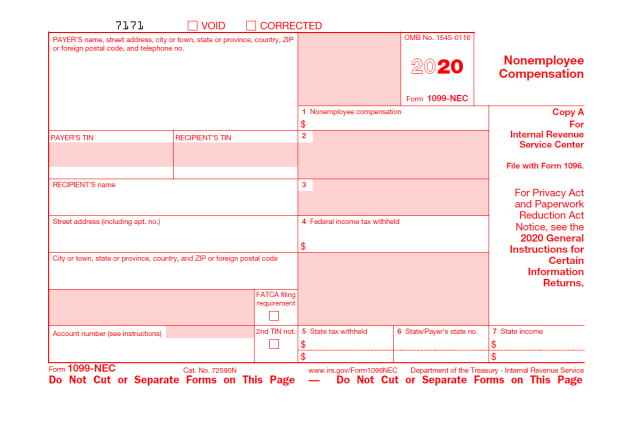
I give you <drumroll please> Form 1099-NEC! This form will replace Form 1099-MISC, Box 7 – Nonemployee Compensation. So, if you made (or think you will be making) payments totaling $600 or more to any independent contractor during calendar year 2020, you’ll need to prepare and file Forms 1099-NEC and 1096 by February 1, 2021. (The deadline to file these forms is usually January 31st, but in 2021 January 31st falls on a Sunday). Do not use Form 1099-MISC, Box 3 – Other Income to report these payments because that is not playing by the IRS’s rules and they really hate that.

To read more about this form, check out this article in Forbes magazine. It gives a pretty good description of the form and who needs to file it. The article was written by my new tax hero(ine), Kelly Phillips Erb, aka “TaxGirl”. Check out her blog here and her podcast here. For additional instructions, you can also consult the IRS’s website for information on Form 1099-NEC and Form 1096.

If you believe you will need to file Form 1099-NEC (or any other Form 1099 and Form 1096), you can order the forms *FOR FREE* from the IRS. Click here to place your order. Do it now because, in a plot twist that no one saw coming, it turns out that the IRS is a little behind on order fulfillment. Hard to believe, I know. The forms they will (eventually) send you are the tractor paper/carbon copy kind that would have probably been useful in like 1987. But they will work if you only have a few forms to fill out and don’t mind writing them by hand. If you need the kind that will go through your laser printer, you will have to purchase those elsewhere (online, Office Depot, etc).

Pro tip: spring for the 1099-specific envelopes at Office Depot. It makes your life easier and looks a whole lot more professional.

Stay tuned!

The fine print: This blog post is for educational and entertainment purposes only and is not intended as a substitute for tax advice. Please consult your tax advisor for guidance on your specific situation.

The IRS Extended the Deadline

You have probably heard by now that the IRS has extended the deadline to both file and pay your 2019 taxes until July 15, 2020.  Read all about the Service’s COVID-19 relief plans here.

So, what does this mean?

This means that the calendar for payments and other deadline-related items has shifted a bit.  The obvious change is the extra time to both file your 2019 tax return (Form 1040 et al) and pay the balance due without penalty on July 15th, 2020 (but see “The Fine Print” below).  However, this affects a few other things I see in my practice:

1.  Estimated tax payments for 2020

The timeline for making estimated tax payments (Form 1040-ES) for 2020 tax has shifted a bit…and it’s a little wonky.  Here it is…

  • 1st quarter 2020 is now due on July 15th, 2020
  • 2nd quarter 2020 is still due on June 15th, 2020 (unchanged – please note that this is BEFORE 1st quarter is due)
  • 3rd quarter 2020 is still due on September 15th, 2020 (unchanged)
  • 4th quarter 2020 is still due on January 15, 2021 (unchanged)

So, if you pay quarterly, don’t miss that first payment for 2nd quarter, due June 15th, which is due before the payment for 1st quarter, due July 15th.  Not confusing.  Not at all.

2.  IRA (Traditional or Roth) and HSA contributions for 2019 tax year

The deadline for these contributions has also been extended until July 15th, 2020.

3.  SEP employer-portion contributions for 2019 tax year

The deadline for these contributions has also been extended until July 15th, 2020.  However, this contribution deadline can be extended further until October 15th, 2020, by filing a valid extension for your tax return.

4.  Tax return extension

You can request an additional 3 months time (until October 15th, 2020) to prepare and submit your completed 2019 tax return.  The deadline to file this extension is now July 15th, 2020.  However, if you anticipate a balance due, it must be paid no later than July 15th to avoid a possible penalty and interest.

So, what do I do?

Well, now would be an excellent time to gather your tax data and submit it to your tax preparer (or prepare your own return, if you’re into that).  If you file quarterly estimated payments, you should try to get your return completed before the June 15th 2nd quarter payment due date.  And, finally, refunds will still be issued within a few weeks of filing your return, so there’s no change there.

You could also send a little thank you note to the IRS Commissioner, Charles P. Rettig.  I’m sure he would love to hear from you.


The Fine Print:  The IRS has postponed the deadline for the “failure to pay” penalty.  If you did not satisfy the requirements of the “safe-harbor” for estimated tax during 2019, it is possible that you may owe an “underpayment” penalty for 2019 tax.  Consult your tax advisor.

Second Quarter 2019 Estimated Tax Payments Due June 17th!

Greetings gentle taxpayers!

If you are not subject to (enough) withholding due to significant self-employment or investment income, you must make quarterly estimated tax payments.  The next one is due Monday, June 17th, 2019.  This payment is must cover estimated tax for the second quarter of 2019 (April-June).  However, if you underpaid (or skipped) the first quarter payment, you need to make up any shortfall from first quarter along with your second quarter payment.  In other words, this second quarter payment plus whatever you paid for first quarter (at April 15th) must equal 50% of your total estimated tax for the year.

Click here to go to the Form 1040-ES forms and instructions.  On pages 3 and 4 you will find a list of the available payment methods.  (Fun fact: the IRS cannot accept a check, personal or cashier’s, for $100 million or more.)  Page 5 has the mailing address information if you pay by sending a check and 1040-ES voucher.  Finally, the second quarter 2019 1040-ES voucher is on page 11.

If you choose to file by mailing in your voucher and a check, be sure you mail it on or before June 17th.  I strongly recommend using certified mail to document the postmark date.

And, oh yeah, have a great summer!