My college buddy, John Clare, is a DJ on SXM’s Symphony Hall. He gave me a shout-out yesterday morning in honor of tax day!
H/T to James Nicholson, AV expert extraordinaire, for getting out of bed early to record it for me.
My college buddy, John Clare, is a DJ on SXM’s Symphony Hall. He gave me a shout-out yesterday morning in honor of tax day!
H/T to James Nicholson, AV expert extraordinaire, for getting out of bed early to record it for me.
Remember that time I wrote about getting IRS notices and how you should not ignore them? No? Go read that post here.
<I’ll wait…>
OK, now that you have read that, you may find an IRS notice sitting in your mailbox.
Don’t panic.
The IRS is sending out notices that say something to the effect of, “You’re getting a stimulus payment. You’re welcome.” This may be the only IRS notice you can nearly ignore. If it says you are getting a payment via direct deposit and you look in your bank account and you received this payment, go ahead and shred the notice (or frame it…whatever). If it says you are getting a payment via direct deposit and the payment doesn’t show up, then you should contact your bank to see if it’s a problem on their end. If everything is OK on the bank’s front, you should contact the IRS. I would first refer you to the IRS website’s “Get My Payment” tool where you can possibly find out the status of the payment. If that doesn’t explain the payment status, contact the IRS using the information on the notice.
Guess who can’t really help you too much with this: me. I can’t do a lot for you because it is not related to your tax return. Without a Power of Attorney, unless it is directly related to a tax return I prepared, I can’t talk to the IRS on your behalf. Additionally, I am not going to be able to get any better information from contacting the IRS than you will. And, finally, it’s the middle of tax season right now. So, if you call me every day asking where you payment is, my answer will be “I don’t know.” And then I will refer you to the IRS website. And then I will probably grumble a little. So, skip the grumbly CPA and head directly to the IRS website for info on that stimmy!
In prior tax years, the charitable contribution deduction has only been available to taxpayers who itemize their deductions. To itemize your deductions, you have to have total deductions (e.g. real estate and sales/state tax, mortgage interest, medical expenses, charitable contributions) in excess of the standard deduction. Recent tax law changes have increased the standard deduction, resulting in fewer taxpayers claiming itemized deductions. This means that many people won’t see any additional tax benefit for their donations. This lead to decreased charitable giving.
In the midst of the pandemic, Congress sought to incentivize more charitable giving though a provision in the CARES act: for the 2020 tax year, taxpayers who take the standard deduction will be able to deduct up to $300 in cash charitable contributions as an “above-the-line” deduction. This means that, if you donate $300 during 2020, you can deduct your full standard deduction plus $300. Right now, for a single person, that means a combined deduction up to $12,700 ($12,400 standard deduction + $300 charitable contribution deduction). At present time, the IRS has not issued guidance on whether a married couple filing jointly will be entitled to a $300 or $600 deduction for 2020 charitable donations. So, a married couple filing a joint return could see a 2020 total deduction up to either $25,100 or $25,400 ($24,800 standard deduction + $300 or $600 charitable contribution deduction).
Of course, some restrictions apply. First of all, you must take the standard deduction to be eligible for this charitable donation “above-the-line” deduction. If you elect to itemize, all of your charitable contributions will be deducted “below-the-line” through Schedule A. Next, the donations must be made in cash. So, cleaning out your closet and taking huge bags of old clothes to Salvation Army will not garner you a deduction for this purpose.* You must make the donation via cash, check, or credit/debit card and follow the IRS’s documentation requirements for cash contributions.** Also, the contribution must be donated outright to a qualified charity; it cannot be a contribution to a donor-advised fund. Finally, the contribution must be completed during calendar year 2020. This deduction has not been made available for 2021.
You are probably wondering how much tax savings you can expect if you max out this new deduction. Well, if you are in the very top tax bracket of 37%, your tax savings on the $300 deduction will total $111. Most people will see a tax savings in the range of $30 – $72. Since it is an “above-the-line” deduction, it will lower your adjusted gross income (“AGI”), which could enhance your ability to claim certain other credits or deductions. If you live in a state with state income tax, the lower AGI could affect your state income tax liability.
So donate some dough to your favorite charity! If you don’t have a favorite charity, donate to a performing arts organization — many of them are hurting right now with the lockdown restrictions due to the pandemic. In any case, don’t miss out on this little gift from Congress!
FOOTNOTES:
* You can still deduct non-cash charitable contributions, but only as itemized deductions on Schedule A. If you elect to itemize your deductions, you are not eligible to take this additional “above-the-line” $300 charitable contribution deduction.
** See IRS Publication 526: Charitable Contributions, page 20, for substantiation requirements.
The fine print: This blog post is for educational and entertainment purposes only and is not intended as a substitute for tax advice. Please consult your tax advisor for guidance on your specific situation.
Nope, not confusing at all.
The IRS has done it again! They invented a new form! <Insert light applause here>
Never mind that they can’t get tax returns from March processed…they spent all those long days in quarantine coming up with…more paperwork! Was this the result of a failed IRS drinking game? Did somebody lose a bet? We will never know. What we do know is that the IRS came up with a separate form to replace one box on a very commonly used form because that won’t confuse anybody.
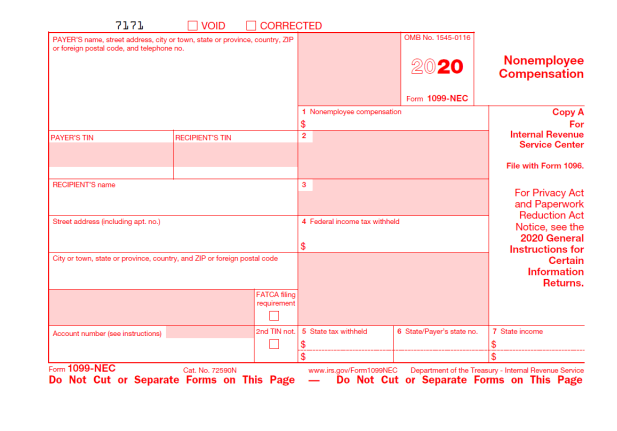
I give you <drumroll please> Form 1099-NEC! This form will replace Form 1099-MISC, Box 7 – Nonemployee Compensation. So, if you made (or think you will be making) payments totaling $600 or more to any independent contractor during calendar year 2020, you’ll need to prepare and file Forms 1099-NEC and 1096 by February 1, 2021. (The deadline to file these forms is usually January 31st, but in 2021 January 31st falls on a Sunday). Do not use Form 1099-MISC, Box 3 – Other Income to report these payments because that is not playing by the IRS’s rules and they really hate that.

To read more about this form, check out this article in Forbes magazine. It gives a pretty good description of the form and who needs to file it. The article was written by my new tax hero(ine), Kelly Phillips Erb, aka “TaxGirl”. Check out her blog here and her podcast here. For additional instructions, you can also consult the IRS’s website for information on Form 1099-NEC and Form 1096.
If you believe you will need to file Form 1099-NEC (or any other Form 1099 and Form 1096), you can order the forms *FOR FREE* from the IRS. Click here to place your order. Do it now because, in a plot twist that no one saw coming, it turns out that the IRS is a little behind on order fulfillment. Hard to believe, I know. The forms they will (eventually) send you are the tractor paper/carbon copy kind that would have probably been useful in like 1987. But they will work if you only have a few forms to fill out and don’t mind writing them by hand. If you need the kind that will go through your laser printer, you will have to purchase those elsewhere (online, Office Depot, etc).
Pro tip: spring for the 1099-specific envelopes at Office Depot. It makes your life easier and looks a whole lot more professional.
Stay tuned!
The fine print: This blog post is for educational and entertainment purposes only and is not intended as a substitute for tax advice. Please consult your tax advisor for guidance on your specific situation.
You have probably heard by now that the IRS has extended the deadline to both file and pay your 2019 taxes until July 15, 2020. Read all about the Service’s COVID-19 relief plans here.
This means that the calendar for payments and other deadline-related items has shifted a bit. The obvious change is the extra time to both file your 2019 tax return (Form 1040 et al) and pay the balance due without penalty on July 15th, 2020 (but see “The Fine Print” below). However, this affects a few other things I see in my practice:
The timeline for making estimated tax payments (Form 1040-ES) for 2020 tax has shifted a bit…and it’s a little wonky. Here it is…
So, if you pay quarterly, don’t miss that first payment for 2nd quarter, due June 15th, which is due before the payment for 1st quarter, due July 15th. Not confusing. Not at all.
The deadline for these contributions has also been extended until July 15th, 2020.
The deadline for these contributions has also been extended until July 15th, 2020. However, this contribution deadline can be extended further until October 15th, 2020, by filing a valid extension for your tax return.
You can request an additional 3 months time (until October 15th, 2020) to prepare and submit your completed 2019 tax return. The deadline to file this extension is now July 15th, 2020. However, if you anticipate a balance due, it must be paid no later than July 15th to avoid a possible penalty and interest.
Well, now would be an excellent time to gather your tax data and submit it to your tax preparer (or prepare your own return, if you’re into that). If you file quarterly estimated payments, you should try to get your return completed before the June 15th 2nd quarter payment due date. And, finally, refunds will still be issued within a few weeks of filing your return, so there’s no change there.
You could also send a little thank you note to the IRS Commissioner, Charles P. Rettig. I’m sure he would love to hear from you.
Greetings gentle taxpayers!
If you are not subject to (enough) withholding due to significant self-employment or investment income, you must make quarterly estimated tax payments. The next one is due Monday, June 17th, 2019. This payment is must cover estimated tax for the second quarter of 2019 (April-June). However, if you underpaid (or skipped) the first quarter payment, you need to make up any shortfall from first quarter along with your second quarter payment. In other words, this second quarter payment plus whatever you paid for first quarter (at April 15th) must equal 50% of your total estimated tax for the year.
Click here to go to the Form 1040-ES forms and instructions. On pages 3 and 4 you will find a list of the available payment methods. (Fun fact: the IRS cannot accept a check, personal or cashier’s, for $100 million or more.) Page 5 has the mailing address information if you pay by sending a check and 1040-ES voucher. Finally, the second quarter 2019 1040-ES voucher is on page 11.
If you choose to file by mailing in your voucher and a check, be sure you mail it on or before June 17th. I strongly recommend using certified mail to document the postmark date.
And, oh yeah, have a great summer!

This is the voucher I’m talking about. It can be found at IRS.gov.
…is due on Tuesday, January 15th, 2019. Be sure your 4th quarter 1040-ES voucher and payment are postmarked on or before this date. I recommend sending it certified mail with return receipt requested to prove mailing date and delivery.
That is all…for now.
If you wish to purchase health insurance for 2019 on the ACA Marketplace, open enrollment is NOW! The open enrollment period ends on December 15th, which is right around the corner. Even if you already have a policy set to renew through the ACA Marketplace, it’s still worth the time to make sure there’s not a better deal or policy out there to suit your needs. After December 15th, you need to have a “major life event” to enroll in an ACA plan, so don’t miss this deadline!
I will be out of the country without my computer/tax software from December 16th through January 4th. If you need any year-end advice or projections, please contact me as soon as possible.
I’m not ignoring you…I’m ignoring everybody.
You got your mail and, nestled in between the Val-Pak and the grocery circular, there is a letter addressed to you from the Internal Revenue Service. As you break into a cold sweat, the world starts to get kinda fuzzy…

First, you should remember to breathe. The next thing you should do is open it. Read it. Make sure the name and social security number match yours. Try to assess why they are writing you. Find the tax return or filing referenced and compare the IRS notice to your records. Call your tax preparer or adviser to discuss the issue at hand and what action should be taken.* While there are occasional exceptions, the vast majority of IRS notices will require a response in a timely manner.
Ignore it. Hope it will go away. Procrastinate dealing with it. As I said above, most notices require a response. Ignoring one IRS notice will generally cause another follow-up IRS notice. This second notice (or third or…) is usually not as pleasant as the first one, so you don’t want to let it get to that point.

You can get IRS notices for many different reasons. Most of the time (like 95%+ in my experience) you can resolve the issue by responding with a letter and perhaps attaching some documentation to back up your position. There are a few, though, that require serious attention:
While I want to stress that legitimate IRS notices should never be ignored, there are a lot of scams out there that should be either ignored (at the very least) or reported to the authorities (better). The IRS will never make initial contact with you by telephone or email, and will never ever contact you on social media. The IRS will not send you written correspondence asking you to verify personal information like your social security number (because they’ve got that), bank account number (they’ve already got that too), or PIN# (they don’t need that). The IRS will not demand that you pay an assessment immediately or risk arrest/deportation/suspension of business license. The IRS will not request payment in the form of prepaid cards or cash. In short, if you get a robocall saying you’ve “done a fraud with IRS” and they are going to come arrest you if you don’t send them $500 in prepaid Starbucks gift cards, it’s a scammer.**
I write this as a sort of general public service/informational/entertainment-only posting. It is not meant to cover all types of IRS correspondence, nor should it serve as a substitute for advice from a tax professional. If you receive any notice or other correspondence from the IRS, please consult your tax adviser.
Best wishes that your Val-Pak and grocery circular come to your mailbox free of IRS notices!