HSA: Heads You Win, Tails You Win Too

This is the closest thing to a 20-pound box of chocolates from the IRS…

There are very few things in the tax code that are rigged in favor of the taxpayer. The Roth IRA is pretty good…but the one that pulls out all the stops is the Health Savings Account (“HSA”). An HSA is a tax-advantaged account for the payment of qualified medical expenses. It is available to taxpayers who are covered by health insurance that qualifies as a high deductible health plan (“HDHP”)1. There are several reasons why I think the HSA may be even better than that tax-advantaged darling, the Roth IRA. Read on!

HSA Contributions. Contributions to an HSA are deductible in the year of contribution (take that, Roth IRA – ha!). If contributed directly to an HSA account, they are deducted from your adjusted gross income (“above the line” – the good kind of deduction). If they are contributed through an employee’s payroll deferral, they are pre-tax and exempt from employment taxes (i.e., FICA and Medicare). Additionally, employers are permitted to partially or fully fund their employees’ HSA accounts free of tax to the employee. Maximum contributions are based on the type of coverage an employee has under an HDHP:

Type of HDHP coverage   20232024
 Employee only$3,850$4,150
 Family$7,750$8,300
Age 55+ catch-up contribution$1,000$1,000

This allows a married couple with family HDHP coverage and both spouses age 55 or older to contribute a total of $10,300 ($8,300 + $1,000 + $1,000) to their HSA accounts in 2024.2

HSA Distributions. Distributions from an HSA are tax-free if they are used to pay or reimburse eligible medical expenses3. This can include costs for doctors, dentists, hospitals, lab tests, and prescriptions as well as certain over-the-counter items such as NyQuil, Advil, Bandaids, sunscreen, tampons(!), and condoms(!!). The funds can also be used to reimburse certain Medicare and long-term care insurance premiums. These eligible distributions can be taken at any age and can occur either the year the medical expense is incurred or any year thereafter. For a taxpayer under age 65, any distribution in excess of eligible medical expenses will be subject to tax plus a 10% penalty. Taxpayers 65 or older are permitted to take HSA distributions for any reason without penalty, but the distribution in excess of medical expenses will be taxable.

How is this different from flex-spending? So, this HSA sounds pretty good – deductible contributions, non-taxable distributions – but how is it different than a flex-spending account (“FSA”)? If you have an FSA, you are familiar with the concept of “use it or lose it”. Such is not the case with the HSA. The HSA funds belong to the taxpayer and can be kept in the HSA for years, even after separation from an employer.

So what’s the strategy? The strategy for maximum HSA benefit is to treat it just like you treat your other retirement accounts: invest that money and leave it alone! In the meantime, pay your medical expenses out-of-pocket and (this is key) save your medical expense receipts. Then, years later, once your HSA investments have grown, reimburse yourself for those prior year medical expenses tax-free. This way, you maximize the tax advantage of the income and appreciation of your HSA investments.

HSA Summary and Example. The HSA is a triple tax benefit…

  • Contributions are deductible/pre-tax (and not subject to payroll tax)
  • Growth and income within the HSA is tax-free4
  • Distributions (including any appreciation) for medical expenses are tax-free

Trixie Taxie, 51, and her wife Lexie, 56, are covered by a family HDHP plan at Trixie’s work in 2023. Trixie takes full advantage of the available HSA, contributing $7,750 from her paycheck. These funds come out of her check pre-tax and are not subject to FICA/Medicare payroll taxes. Because Lexie is 55 or older, she is eligible to contribute a 2023 catch-up contribution of $1,000 in addition to the $7,750 Trixie has already contributed. Lexie must establish an HSA in her own name and contribute the additional $1,000 by April 15, 2024. Lexie’s contribution will be deducted directly from adjusted gross income on the couple’s 2023 joint income tax return. Both spouses invest the funds as instructed by their personal financial advisors.

In 2023, Trixie and Lexie have their usual medical expenses and also purchase some over-the-counter medicines and supplies. They pay for these expenses out of pocket and save the receipts, leaving their HSA funds to grow in their investments.

Fast-forward to 2040…Trixie and Lexie are both retired and on Medicare. The $8,750 they put into their HSAs and invested wisely in 2023 has now grown to over $20,000. They can use this money (all $20,000 of it) tax-free to reimburse themselves for their Medicare premiums or for any other prior or current year eligible medical expense. Remember those medical expense receipts they saved back in 2023? They can reimburse themselves for those at any time.

It’s just too good to pass up! If you were covered by an HDHP in 2023, you have until April 15, 2024 to fully fund this miraculous account. Don’t miss out!

  1. Any taxpayer on Medicare is no longer eligible to contribute to an HSA. ↩︎
  2. This would require both spouses to have HSA accounts and at least $1,000 would need to be contributed to each spouse’s account. However, both spouses could be covered by the same HDHP. ↩︎
  3. Expenses must be incurred after the HSA is established to be eligible for reimbursement. ↩︎
  4. Tax-free if distributed for qualified medical expenses; tax-deferred if distributed for any other reason. ↩︎

I provide this for educational and entertainment purposes only. Please consult your own advisors.
Got kids?

You may qualify for dependent care credit, but you need to have all the info.

When you brought that little tax credit…er…I mean bundle of joy…home from the hospital, you knew your life was going to change. You now have this tiny, helpless creature that must be supervised and cared for. All. The. Time. At some point in time, it is very likely that you will need to pay someone to care for your offspring while you venture forth to make money in order to house, feed, and clothe this brand new human. If you do so, you may be eligible for something called the Dependent Care Credit1.

What expenses can I claim for this credit? Subject to a few limitations, it is generally any unreimbursed2 payments you make for child care of a dependent under age 13 while you are working3. This can be self-employed work or W-2 employment. Here are a few examples of unreimbursed child care payments that would qualify:

  • Daycare/childcare centers
  • Pre-Kindergarten preschool or nursery school
  • Nanny (household employee)4
  • Day camp
  • Some after-school activities
  • Babysitters

There are a couple providers that specifically do not qualify:

  • Overnight camp
  • Tutoring or other private lessons
  • Transportation to or from care provider (unless transportation is provided by that care provider)
  • Child’s parent or minor sibling5

Great – I paid a ton of money for that. What do I do to get this credit? In order to claim the credit, you need to give your tax preparer the following info on each care provider:

  • Name of provider
  • Provider tax identification number (EIN or SSN)
  • Provider address
  • Care location (if different)
  • Provider phone number
  • Amount paid during the tax year, allocated to each dependent

You noticed the second item – tax ID number. This information is usually listed on the year-end statement provided by most daycare centers, day camps, or other care providers. If you employ a nanny, you should have this from the Form W-4 you collected when you hired them (because you are sending them a W-2, right? <nod with me>). However, if, for example, you paid a neighborhood kid or two to watch your children while you worked, you will need to get a Form W-10 to request the social security number of those providers. If you think you will need a Form W-10, request it as soon as possible.6

I can work with that. How much credit do I get for this? It’s actually a bit disappointing. The credit is figured on a sliding scale based on your modified adjusted gross income. Without getting into a whole bunch of math, I find most people max out this credit at $600 for one qualifying dependent and $1,200 for two or more.7 But, hey, better than nothing. And you never know what those crazy folks in Congress are going to do with the tax code.

So, as you gather up your tax data, be sure to collect those dependent care expenses and all the info that goes with them!

  1. This credit is in addition to the general child tax credit you may be eligible for. ↩︎
  2. Childcare expenses that are reimbursed through an employer’s flexible spending arrangement (“FSA”) are not eligible for this credit. But if you have dependent care expenses in excess of the FSA reimbursement, they can be used to claim this credit. Additionally, your tax preparer needs to report at least the amount of dependent care expenses as you claimed during the tax year. So you still need to give them all this information. ↩︎
  3. This credit is also available for other dependents like disabled parents or disabled older children. However, I am limiting this post to dependent care credit for children under age 13. ↩︎
  4. If you hire a nanny or a related party for child care, there are some additional requirements in order to render these payments eligible for the credit. ↩︎
  5. Seriously, people have tried to pay the other parent to “babysit” their own child. You cannot babysit your own child. It’s called parenting. /rant ↩︎
  6. In the future, it is better to get the Form W-10 from the provider before care commences or payment is made. Also, this does not mean you will be required to issue any sort of Form 1099 to the provider(s). ↩︎
  7. This is calculated based on the tax law in effect at the time of this writing. There is legislation pending in Congress that could alter this and other child-related tax credits. Please consult your tax advisor for the most recent developments. ↩︎

To 1099 or not to 1099?

If you are an independent contractor (aka “a freelancer”), chances are good that you have been the recipient of a Form 1099-NEC (or several) somewhere along the way. However, did you know that you may be required to file them too? Read on…

Why, you ask, would I need to file such a form?  Well, if you paid any person(s) $600 or more to provide services in the course of your business1 during 2023, you are required to prepare and file Form(s) 1099-NEC2 for them by January 31, 2024.

What do you mean “person”?  Well, a “person” in this circumstance is an individual, sole proprietor, partnership, or LLC that is NOT organized as a corporation.  So, if you paid Frank the Painter, Inc. (an S-Corporation) $700 to paint your rental house, you are off the hook and do not have to send a 1099 to his corporation.  But if you hired Gina Smith, an unincorporated sole proprietor, to repair your rental house plumbing for $600 or engaged Dewey, Cheatham & Howe, LP for $1,000 of legal consulting3 for your self-employed business, you will need to send Gina and/or DC&H a Form 1099-NEC.

What if I paid a guy I found on Craigslist $750 to buy a water heater for my rental?  Do I need to send that guy a 1099-NEC too?  Nope, 1099-NECs are only for service or labor payments, not purchases of goods or equipment. However, if you are issuing a Form 1099 to a contractor who supplied or installed materials and equipment incidental to the services they were providing, then you would include the entire amount of the payment on the Form 1099.

Okay, well what do I need to do to prepare these 1099-NECs?  The first thing is you need to get a Form W-9 from anybody you paid $600 or more during 2023.  (Really, it is better to get the W-9 from anyone your business hires before any work commences or money changes hands…but better late than never.)  This will give you the person’s legal name, current address, taxpayer identification number/social security number, and a confirmation of their federal tax classification (i.e., individual, partnership, corporation, etc.).  Then, if you plan to prepare and file the Forms 1099-NEC yourself, I would take a peek at the IRS Form 1099-NEC filing instructions for some guidance. You can either purchase the special paper 1099 and 1096 forms (no, you can’t download them from the IRS website), fill them out, and mail them in (only permitted if you have 10 or fewer forms to file), or you can use an online service to file them electronically (now required if you have more than 10 Forms 1099-NEC to file).4  Or you can always hire an accountant to help you… <ahem>

So what terrible thing is going to happen if I don’t file Forms 1099-NEC? To be blunt, you will pay penalties and wind up filing them anyway. The IRS hates this, and they have started hating it even more in recent years. If you are supposed to file Forms 1099 and you fail to do so, the IRS deems those Forms 1099 to be late. They then charge late penalties of anything from $60 to $630 per form depending on how late it is. That’s per Form 1099. So if you have 10 Forms 1099-NEC to file, you could be on the hook for up to $6,300 in penalties…and you’ll still have to file the forms. The penalties are severe, so it is really best to get these forms filed timely (that is, by January 31st).

Take a look at your tax records to determine if your business paid anybody $600 or more during 2023. If you did, gather the info and get those Forms 1099-NEC done as soon as possible!

  1. “Business” could mean a trade or business activity (like freelance musician or tax preparer) or a rental activity (like a landlord or an AirBnB host). ↩︎
  2. Yes, Form 1099-NEC. Not Form 1099-MISC. Go back and read my prior post on this. We haven’t been using Form 1099-MISC for “Nonemployee Compensation” since tax year 2019. If you’ve been using Form 1099-MISC for the past three years, well, you’re doing it wrong. ↩︎
  3. There are some special rules for legal fees. Consult your tax advisor if you may have this issue. ↩︎
  4. The IRS has recently unveiled its new online efiling service for information returns like Forms 1099. It’s called the “Information Returns Intake System” or IRIS. So cute…so floral…so, evidently, dysfunctional. Surprisingly (or not), every practitioner I have heard from has had problems with the system locking them out. So, for this year, I would investigate a different filing method (either paper, if eligible, or a commercial efiling service) for your Form 1099 filing needs. ↩︎

I provide this for information or entertainment purposes. It should not be construed as tax advice.Please consult your tax advisor to address your specific tax filing needs.

That’s so gross!

Why do you keep using the word “gross” all the time…?

You’ve probably heard the term “gross receipts” and wondered what that means. No, it’s not cash register tape that’s…like…sticky. (I hate ‘sticky’…) “Gross receipts” is the total amount of compensation you received before any expenses are deducted. Accounting types (like me!) will also refer to this concept as “revenue” or sometimes “gross income”.

This “gross” concept can pop up in different places on your tax return. We might have “gross wages”, which we find on your Forms W-2. Or there’s “gross rents” which is everything you collected from your renters if you have rental properties. However, the place where I see the most confusion with “gross receipts” is with self-employment income.

Gross receipts from self-employment income generally include every dime you receive in the course of doing business. It may be reported to you on Form 1099-NEC. This form is provided to you if you earned $600 or more from any one payer during the tax year. Guess who else this form is provided to…that’s right – the IRS! If you fail to report gross income from Form 1099-NEC on your tax return (likely on Schedule C), you will get a friendly note from the Federal government that includes a bill for the unpaid tax along with interest and penalties to keep it company. That’s generally not something we want to encourage, so we have to make sure to report all that revenue.

But what happens if you don’t receive a Form 1099-NEC? If you earn less than $600 from somebody, that income is not taxable, right? Yeah, no. The reporting threshold for Form 1099 has nothing to do with whether or not the income is taxable. The $200 you earned at that one-off wedding gig? Taxable. The student that pays you $50 a week in cash for private lessons? Taxable. The Zelle or Venmo payments you receive for providing a service to a client? Taxable. Essentially any money you receive in the course of your freelance business is taxable and should be included with your Schedule C gross receipts.1

But, what if you don’t get 1099s from your students and didn’t get them from several of the gigs you played. How are you supposed to figure this out? Well, gentle taxpayer, you must acquaint yourself with the concept of record keeping. You are running a business, so you have to do some work behind the scenes to keep track of this business. You don’t have to get QuickBooks or take accounting classes (been there/done that). But you do need to figure out a system so you can accurately report your income.

So where should you start? Well, there are a couple things you can do to get organized. The first thing I would recommend is to open a checking account for your self-employed business income only. Deposit all your self-employment gross receipts into that account (and nothing else — keep any W-2 wages or other types of income in a separate account). That way, at the end of the year, you can run a report of the business account’s activity and add up all the deposits. You can also use this account to pay business expenses when possible. Whatever is leftover can be transferred into your personal account.

A dedicated bank account is something the IRS loves. They also love a dedicated credit card. If you are a credit card person, designate one as your “business” card and use it only for business expenses. That will make tax time a little easier too.

Finally, to pull it all together, you can look into a budgeting or accounting program like You Need a Budget (“YNAB”) or Xero. This is kinda for extra credit, but it can give you some insight into how much you’ve earned year-to-date (helpful for estimated taxes) and can give you reports at tax time. And, not surprisingly, it can help you set your budget.

  1. Gross rant: If you give me a stack of 1099-NECs and say that’s 100% of your freelance gross income…but I know you teach and I’m pretty sure I played a gig with you that isn’t on a 1099…I will not believe you and will ask again about your total gross receipts. I’ve got liability too…especially if I believe you’re intentionally underreporting your income. That’s also known as “fraud”. The IRS preparer penalties for me if you (we) are caught are not worth the tax prep fee you pay. I will not think twice about telling you to find another CPA if I know, or strongly suspect, that you are being dishonest about this. /rant ↩︎

This information is for entertainment or educational purposes only. Please consult your tax advisor for advice on your specific tax situation.

Introducing the new Form 1099…

Nope, not confusing at all.

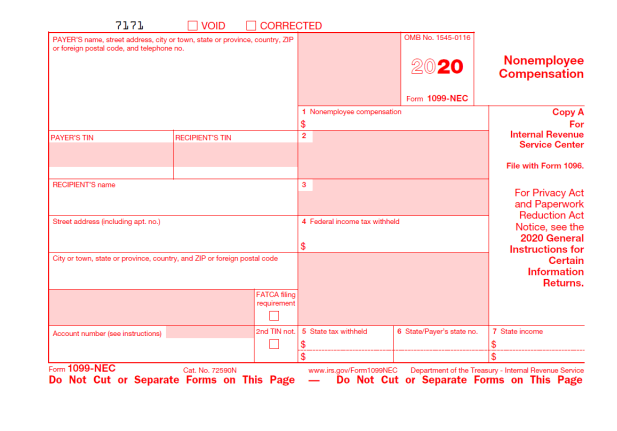
The IRS has done it again! They invented a new form! <Insert light applause here>

Never mind that they can’t get tax returns from March processed…they spent all those long days in quarantine coming up with…more paperwork! Was this the result of a failed IRS drinking game? Did somebody lose a bet? We will never know. What we do know is that the IRS came up with a separate form to replace one box on a very commonly used form because that won’t confuse anybody.

I give you <drumroll please> Form 1099-NEC! This form will replace Form 1099-MISC, Box 7 – Nonemployee Compensation. So, if you made (or think you will be making) payments totaling $600 or more to any independent contractor during calendar year 2020, you’ll need to prepare and file Forms 1099-NEC and 1096 by February 1, 2021. (The deadline to file these forms is usually January 31st, but in 2021 January 31st falls on a Sunday). Do not use Form 1099-MISC, Box 3 – Other Income to report these payments because that is not playing by the IRS’s rules and they really hate that.

To read more about this form, check out this article in Forbes magazine. It gives a pretty good description of the form and who needs to file it. The article was written by my new tax hero(ine), Kelly Phillips Erb, aka “TaxGirl”. Check out her blog here and her podcast here. For additional instructions, you can also consult the IRS’s website for information on Form 1099-NEC and Form 1096.

If you believe you will need to file Form 1099-NEC (or any other Form 1099 and Form 1096), you can order the forms *FOR FREE* from the IRS. Click here to place your order. Do it now because, in a plot twist that no one saw coming, it turns out that the IRS is a little behind on order fulfillment. Hard to believe, I know. The forms they will (eventually) send you are the tractor paper/carbon copy kind that would have probably been useful in like 1987. But they will work if you only have a few forms to fill out and don’t mind writing them by hand. If you need the kind that will go through your laser printer, you will have to purchase those elsewhere (online, Office Depot, etc).

Pro tip: spring for the 1099-specific envelopes at Office Depot. It makes your life easier and looks a whole lot more professional.

Stay tuned!

The fine print: This blog post is for educational and entertainment purposes only and is not intended as a substitute for tax advice. Please consult your tax advisor for guidance on your specific situation.