NEW FOR 2020: Extra Charitable Contribution Deduction

In prior tax years, the charitable contribution deduction has only been available to taxpayers who itemize their deductions. To itemize your deductions, you have to have total deductions (e.g. real estate and sales/state tax, mortgage interest, medical expenses, charitable contributions) in excess of the standard deduction. Recent tax law changes have increased the standard deduction, resulting in fewer taxpayers claiming itemized deductions. This means that many people won’t see any additional tax benefit for their donations. This lead to decreased charitable giving.

In the midst of the pandemic, Congress sought to incentivize more charitable giving though a provision in the CARES act: for the 2020 tax year, taxpayers who take the standard deduction will be able to deduct up to $300 in cash charitable contributions as an “above-the-line” deduction. This means that, if you donate $300 during 2020, you can deduct your full standard deduction plus $300. Right now, for a single person, that means a combined deduction up to $12,700 ($12,400 standard deduction + $300 charitable contribution deduction). At present time, the IRS has not issued guidance on whether a married couple filing jointly will be entitled to a $300 or $600 deduction for 2020 charitable donations. So, a married couple filing a joint return could see a 2020 total deduction up to either $25,100 or $25,400 ($24,800 standard deduction + $300 or $600 charitable contribution deduction).

Of course, some restrictions apply. First of all, you must take the standard deduction to be eligible for this charitable donation “above-the-line” deduction. If you elect to itemize, all of your charitable contributions will be deducted “below-the-line” through Schedule A. Next, the donations must be made in cash. So, cleaning out your closet and taking huge bags of old clothes to Salvation Army will not garner you a deduction for this purpose.* You must make the donation via cash, check, or credit/debit card and follow the IRS’s documentation requirements for cash contributions.** Also, the contribution must be donated outright to a qualified charity; it cannot be a contribution to a donor-advised fund. Finally, the contribution must be completed during calendar year 2020. This deduction has not been made available for 2021.

You are probably wondering how much tax savings you can expect if you max out this new deduction. Well, if you are in the very top tax bracket of 37%, your tax savings on the $300 deduction will total $111. Most people will see a tax savings in the range of $30 – $72. Since it is an “above-the-line” deduction, it will lower your adjusted gross income (“AGI”), which could enhance your ability to claim certain other credits or deductions. If you live in a state with state income tax, the lower AGI could affect your state income tax liability.

So donate some dough to your favorite charity! If you don’t have a favorite charity, donate to a performing arts organization — many of them are hurting right now with the lockdown restrictions due to the pandemic. In any case, don’t miss out on this little gift from Congress!

FOOTNOTES:

* You can still deduct non-cash charitable contributions, but only as itemized deductions on Schedule A. If you elect to itemize your deductions, you are not eligible to take this additional “above-the-line” $300 charitable contribution deduction.

** See IRS Publication 526: Charitable Contributions, page 20, for substantiation requirements.

The fine print: This blog post is for educational and entertainment purposes only and is not intended as a substitute for tax advice. Please consult your tax advisor for guidance on your specific situation.
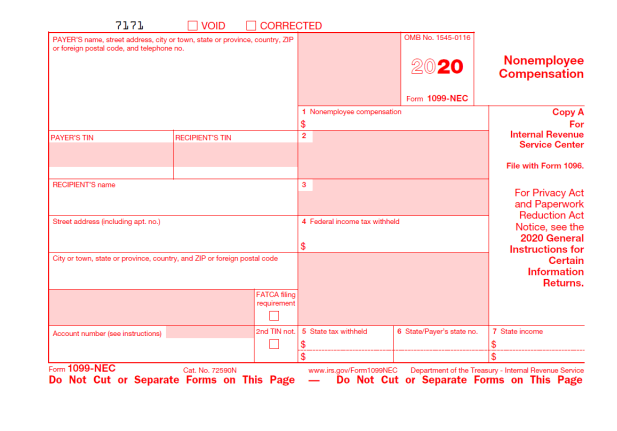
Introducing the new Form 1099…

Nope, not confusing at all.

The IRS has done it again! They invented a new form! <Insert light applause here>

Never mind that they can’t get tax returns from March processed…they spent all those long days in quarantine coming up with…more paperwork! Was this the result of a failed IRS drinking game? Did somebody lose a bet? We will never know. What we do know is that the IRS came up with a separate form to replace one box on a very commonly used form because that won’t confuse anybody.

I give you <drumroll please> Form 1099-NEC! This form will replace Form 1099-MISC, Box 7 – Nonemployee Compensation. So, if you made (or think you will be making) payments totaling $600 or more to any independent contractor during calendar year 2020, you’ll need to prepare and file Forms 1099-NEC and 1096 by February 1, 2021. (The deadline to file these forms is usually January 31st, but in 2021 January 31st falls on a Sunday). Do not use Form 1099-MISC, Box 3 – Other Income to report these payments because that is not playing by the IRS’s rules and they really hate that.

To read more about this form, check out this article in Forbes magazine. It gives a pretty good description of the form and who needs to file it. The article was written by my new tax hero(ine), Kelly Phillips Erb, aka “TaxGirl”. Check out her blog here and her podcast here. For additional instructions, you can also consult the IRS’s website for information on Form 1099-NEC and Form 1096.

If you believe you will need to file Form 1099-NEC (or any other Form 1099 and Form 1096), you can order the forms *FOR FREE* from the IRS. Click here to place your order. Do it now because, in a plot twist that no one saw coming, it turns out that the IRS is a little behind on order fulfillment. Hard to believe, I know. The forms they will (eventually) send you are the tractor paper/carbon copy kind that would have probably been useful in like 1987. But they will work if you only have a few forms to fill out and don’t mind writing them by hand. If you need the kind that will go through your laser printer, you will have to purchase those elsewhere (online, Office Depot, etc).

Pro tip: spring for the 1099-specific envelopes at Office Depot. It makes your life easier and looks a whole lot more professional.

Stay tuned!

The fine print: This blog post is for educational and entertainment purposes only and is not intended as a substitute for tax advice. Please consult your tax advisor for guidance on your specific situation.

It’s Open Season…errr…Enrollment!

If you wish to purchase health insurance for 2019 on the ACA Marketplace, open enrollment is NOW!  The open enrollment period ends on December 15th, which is right around the corner.  Even if you already have a policy set to renew through the ACA Marketplace, it’s still worth the time to make sure there’s not a better deal or policy out there to suit your needs.  After December 15th, you need to have a “major life event” to enroll in an ACA plan, so don’t miss this deadline!


VOTE!

This is not a partisan post.  Just a note to say that it is your civic duty to vote!

Here in Texas, we are in the midst of early voting for the November 6th election.  I drove by the nearest polling place today, and the line went outside, across the porch, down the steps, and down the sidewalk into the parking lot.  I decided to come back tomorrow when I have the entire afternoon off (because I have a wacky schedule).  But I worry that many without my schedule flexibility might not have the time to wait in line or the ability to come back the next day.  I love the high turnout, though!  Please don’t give up!

The end of 2017

Greetings, gentle taxpayers!

I know most people think 2017 ended when the clock struck midnight on December 31st.  However, for tax preparers, the year doesn’t end until the clock strikes midnight on October 15th, the final deadline for extended tax returns.  It can now be 2018 for me.

Of course, as of this writing, there are only 76 sunsets left in (the calendar year) 2018.  The new tax laws going into effect for the 2018 tax year will be a learning experience for all of us (me included, though I probably have a head start).  But some year-end things never change:

-Pay any last minute or end of year Schedule C/freelance business expenses

-Gather up your receipts and do some advance organization

-Consider selling stocks in loss positions

-Save up for 4th quarter estimated payment (1040-ES) due January 15th, 2019 (if applicable)

-Check your year-to-date federal tax withholding (or contact me to do this) to be sure you are on track

-If you prepare Forms 1099-MISC for independent contractors you hire, get updated Forms W-9

Finally, if you filed a little on the late side and are curious about your refund status, please take a look at my blog post “Where’s my refund?!?”.  It may sound a little cranky, but it will show you how to find out when your refund is slated to be direct deposited.

And now, we slide right on out of 2018…

Things to do before the end of the 2017 year…

You probably noticed that a major tax overhaul recently passed. Here are a few actions I would recommend taking before the end of 2017:

  • Pay property taxes on principal residence
  • Pay January student loan and/or mortgage payments early (if the bank will allow it)
  • Make charitable contributions and be sure any non-cash contributions are dropped off before 12/31/2017
  • Pay for any employee business expenses, including union dues, supplies, etc.
  • Complete any planned vehicle (car/boat/RV) purchase

The 2017 tax return will generally follow the old rules; the 2018 returns will be subject to the new tax laws. As I learn more about the new laws, I will provide additional direction on any other actions to take in the new year.

2017 is Coming to a Close

Even though the 2016 filing season just wrapped up, it will be time for 2017 tax returns (and 1099s and Texas Franchise Tax and 2018 Estimated Taxes) before we know it.

Some things to think about BEFORE the end of 2017…

  • If you are worried that you have not paid enough in federal tax withholding for 2017, please contact me now to discuss increasing your withholding or making an estimated payment.
  • If you have some stocks that have fallen and can’t get up, sell before the end of the year to claim a capital loss.*
  • If you are planning a Traditional or Roth IRA contribution, start setting money aside. Contributions to these accounts must be made by April 17, 2018.
  • If you plan to donate to charity (especially if you are donating a large non-cash item like a vehicle), be sure to complete the donations by 12/31/2017 to deduct on the 2017 tax return.**
  • If anything out of the ordinary has happened with your income or expenses during 2017, let me know so we can prepare for any possible tax effects.

It’s not too early to get a head start on collecting your expenses, tallying mileage, and organizing documents for 2017.  I’ll be making a push to get tax returns done early this year, so getting things done ahead of time will be a huge help.

Your favorite CPA,
Meghan

* Subject to capital loss limitations.
** Subject to itemized deduction limitations.